What hydrocolloid is
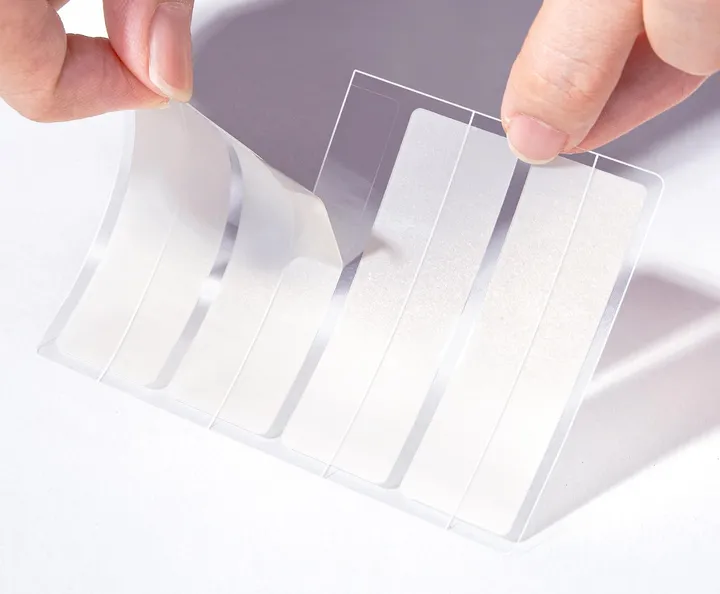
Hydrocolloid is a soft, slightly gummy material that swells when it meets moisture. It is best known as a wound dressing. A pimple patch is the same idea cut into a small sticker.
“Pimple patches are small stickers made with a slightly gummy wound-healing gel called hydrocolloid.”
The material has two layers that matter to you. The outer film keeps water, dirt and fingers out. The inner layer faces the skin and holds on to any fluid it touches.
As the inner layer fills, it turns from clear to cloudy white. That white dot is the patch showing you what it took in. Nothing in a plain hydrocolloid patch needs to soak into your skin for this to happen.
“Hydrocolloid dressings are commonly used in the treatment of chronic wounds by forming a gel-like protective layer upon the dispersion of water, absorbing exudate, and creating a moist environment that promotes healing.”
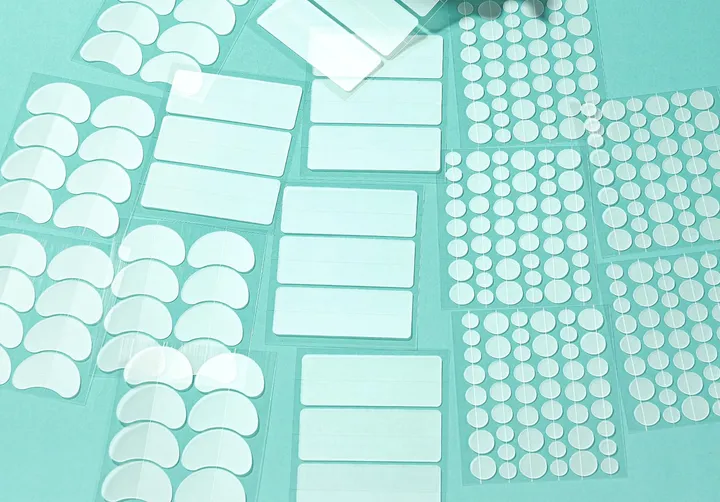
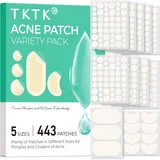
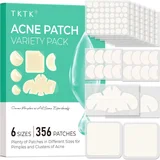
Most of the TKTK range is plain hydrocolloid with nothing added. The Bulk Variety Pack is the usual first box: 443 patches in five sizes for $5.99.
How much research stands behind it
Less than the shelves suggest. A 2025 review of hydrocolloids in dermatology counted only a few studies on acne and asked for more.
“There have been a few studies on their use for treating acne, facial atopic dermatitis, and hypertrophic scarring.”
The trial most often quoted is a pilot from 2006. It tested another company’s dressing on 20 people for one week. Its authors asked for a larger and longer study, and it says nothing about any brand sold today, ours included.
“A total of 20 patients with mild-to-moderate acne vulgaris applied the skin tapes or Acne Dressing every two days for up to one week.”
What a pimple patch does on your skin
A patch does three plain jobs. It covers the spot, and it absorbs fluid from a spot that has come to a head or has opened. It keeps your hands off for as long as it stays on.
“They absorb fluids (like pus and oil) to help drain picked-open zits and unclog pores.”
The third job is the one people underrate. You cannot scratch or squeeze what you cannot reach. A patch on your chin during a long meeting does more for that spot than willpower does.
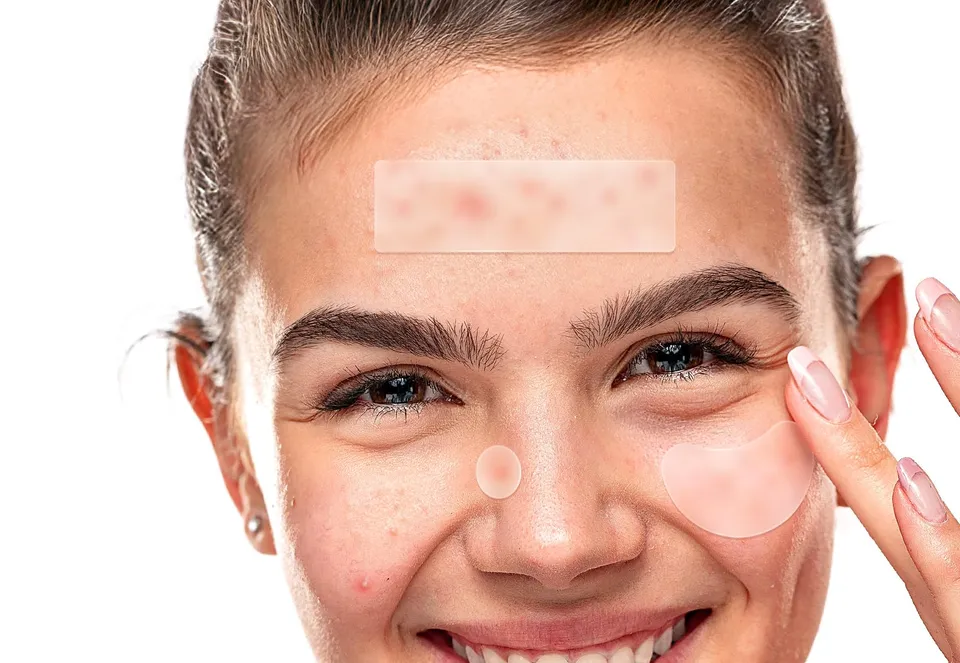
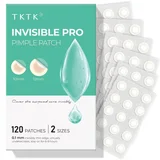
A patch also makes a spot less noticeable while it is on, because it hides the shine and the color. Thin daytime dots such as the Invisible Pro are built for that use. A box of 120 costs $5.38.
What the white dot means
Our own instructions say to peel the patch off after it turns white. A white center means the patch has taken up fluid and has little room left. A patch that stays clear after a full night was sitting on a spot with nothing to give.
That second case is common and it is not a fault of the patch. It tells you the spot was closed or deep.
““For overall acne treatment, there is little use for pimple patches,” emphasizes Dr. Kassouf. “They cannot prevent acne from coming, nor can they clear clogged pores or other precursors to acne flares.””
Which spots suit a patch, and which do not
Look at the spot before you reach for the box. If you can see a white or yellow head, or the spot has already opened, a hydrocolloid patch has fluid to work with. If the skin over it is closed and smooth, it has none.
“These blemishes are a lot like papules, except that pustules contain a yellowish fluid.”
Dermatologists call a spot with visible fluid a pustule. It is the classic patch candidate. A whitehead is close behind it once the top is thin, though a firm, closed whitehead often gives the patch nothing.
“Pustules or pimples: Papules topped by white or yellow pus-filled lesions that may be red at the base.”
Deep, painful lumps
A lump that sits under the skin and hurts when you press it is a different thing. No sticker reaches it. The American Academy of Dermatology still names a hydrocolloid patch for such a spot, and the reason it gives is cover, not drainage.
“Acne nodules and cysts develop deep under your skin, unlike other forms of acne, such as whiteheads or blackheads.”
“Additionally, a hydrocolloid acne patch can be applied to protect your skin and improve healing.”
Read that sentence as written: the patch protects the skin. It keeps you from picking at a lump that should be left alone. If lumps like this come back often, a patch is the wrong tool and a dermatologist is the right one.
Blackheads
A blackhead is an open, plugged pore with no fluid to draw. Hydrocolloid has nothing to grip there. Our XL nose strips are hydrocolloid too, and we sell them for spots on and around the nose, not as a blackhead fix.
The one TKTK product made for blackheads is a different kind of item. The Blackhead Nose Kit is a non-woven strip kit used in three steps, once or twice a week. It contains no hydrocolloid, and the wear times for patches do not apply to it.
| Item | Shape to reach for | TKTK packs with that shape |
|---|---|---|
| One small spot with a head | A round dot, 8 to 14 mm | Original Dots, Clear Cover Dots, Invisible+ Patches, Ultra-Thin Invisible, Invisible Pro |
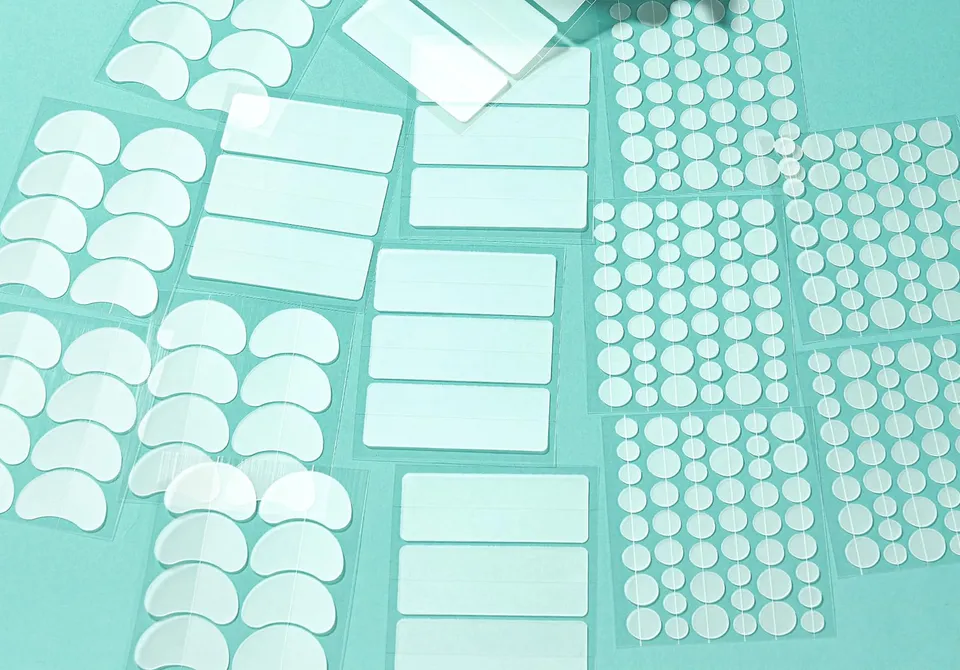
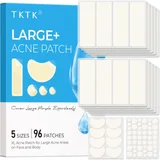
| A row or cluster of spots | A strip, 60 x 20 mm and up | Large+ Strips, Large+ 68 x 27 Strips |
| A wide patch of cheek, back or chest | A square or XL oval | Large+ XL Ovals, Large+ Face and Body, XL Stickers, Large Patches, 4 Big Sizes, 45 mm Squares |
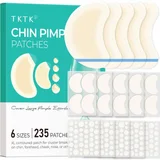
| The curve of the chin or beside the nose | A contoured crescent or moon | Chin Patches, Moon Contoured Patches |
| An odd shape no sticker fits | A length cut from a roll | Hydrocolloid Roll |
Why a patch beats popping
Squeezing feels like progress. Some of what is inside comes out, and the bump looks smaller for an hour. The part you do not see goes the other way.
“When you pop or squeeze acne, you’re likely to push some of what’s inside (e.g., pus, dead skin cells, or bacteria) deeper into your skin.”
Pushed deeper, that material can leave you with a larger, redder spot than the one you started with. Your fingers add their own problem.
“When you pop pimples yourself, you also run the risk of getting an infection from the bacteria on your hands.”
Then comes the mark. Picked spots are the ones that leave dark patches and scars behind, and dermatologists put it in plain words.
“While it can be tempting to pick, pop, or squeeze your acne, doing so will make the acne take longer to clear and increase your risk for scarring and dark spots called post-inflammatory hyperpigmentation.”
A patch is a way to do nothing well. It gives the urge somewhere to go: you put a sticker on and walk away. If the spot is ready, the patch takes the fluid without any pressure from you.
If you have already squeezed, a patch still has a job. An opened spot leaks for a while, and a covered one is harder to keep picking. Clean the area, dry it and cover it.
How to put a TKTK patch on, step by step
TKTK boxes print much the same short routine. It takes under a minute, and most failures trace back to skipping the first step.
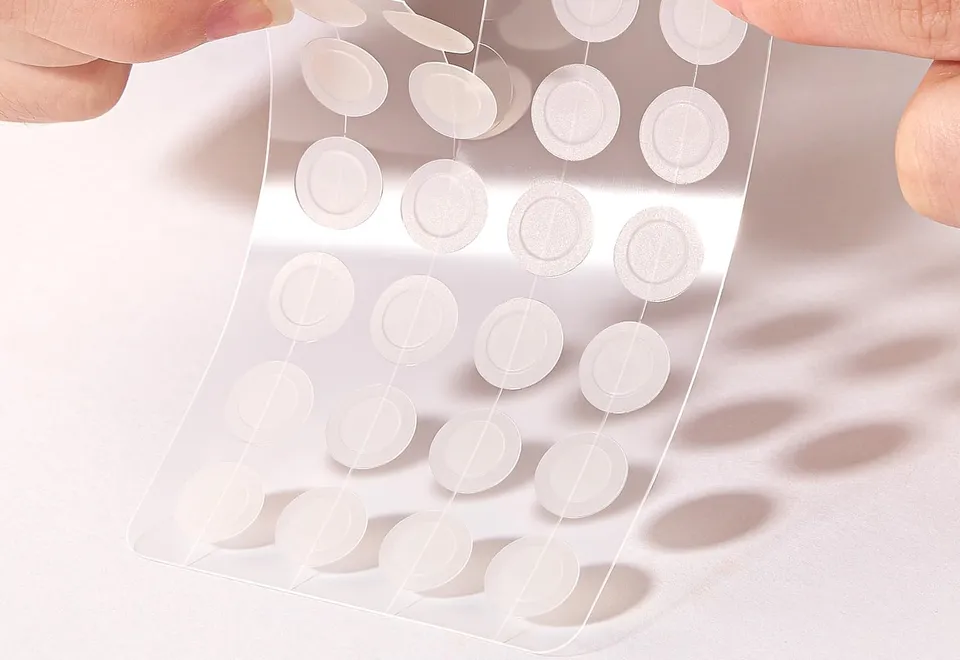
Wash and dry the spot
Cleanse the area and let it dry fully. Our instructions add one rule in brackets: do not apply moisturizer first.
Choose a size that overlaps
The patch should cover the spot with a margin of flat skin all round. For a 5 mm spot that means a 10 or 12 mm dot, not an 8.
Peel and press
Lift the patch by its edge without touching the sticky side. Lay it over the spot and press for 3 to 5 seconds so the rim seals.
Leave it alone
Wear it for the time your pack gives, usually overnight or 6 to 8 hours. A patch that has been peeled back and pressed down again holds less well.
Remove when it turns white
Peel slowly from one edge. If the spot is still weeping, clean, dry and apply a fresh patch.
How long each pack says to wear it
Wear times differ a little from box to box. Some packs give two figures, one for a short wear and one for the night.
| Item | Stated wear time | Pack line |
|---|---|---|
| Original Dots | Overnight, 4 to 8 hours | Acne Patch |
| Clear Cover Dots | Overnight | Acne Patch |
| Bulk Variety Pack | Overnight, 4 to 6 hours, 6 to 8 hours, at least 4 hours | Acne Patch Variety Pack |
| Microdart Patches | Overnight, 4 to 6 hours, at least 6 hours | Microdart Acne Patch |
| All-in-One Combo Pack | Overnight, 4 to 6 hours, 6 to 8 hours, at least 6 hours | Variety Pack |
| Invisible+ Patches | Overnight, 4 to 6 hours, 6 to 8 hours, no more than 12 hours | Invisible+ Patch |
| Ultra-Thin Invisible | Overnight, 4 to 6 hours | Invisible+ Acne Patch |
| Large+ Strips | Overnight, 6 to 8 hours | Large+ Acne Patch |
| Large+ XL Ovals | Overnight, 6 to 8 hours | Large+ Acne Patch |
| Large+ Face and Body | Overnight, 6 to 8 hours | Large+ Acne Patch |
| XL Stickers | Overnight, 6 to 8 hours | Large+ Acne Patch |
| Large Patches, 4 Big Sizes | Overnight, 4 to 6 hours, 6 to 8 hours, at least 6 hours | Large+ Acne Patch |
| 45 mm Squares | Overnight, 6 to 8 hours | Large+ Acne Patch |
| Large+ 68 x 27 Strips | Overnight | Large+ Acne Patch |
| Variety Pack, 4 Shapes | Overnight, 6 to 8 hours, at least 4 hours | Variety Pack Acne Patch |
| Large+ Nose Patch | Overnight, 4 to 6 hours, 6 to 8 hours | Large+ Nose Patch |
| Chin Patches | Overnight, 4 to 6 hours, 6 to 8 hours | Chin Pimple Patches |
| Moon Contoured Patches | Overnight, 4 to 6 hours, 6 to 8 hours, at least 4 hours | Large+ Acne Patch |
| Blackhead Nose Kit | 10 to 15 minutes, 15 to 20 minutes | Blackhead Nose Patches |
Two entries need a note. The Invisible+ Patches sets an upper limit of 12 hours, the only pack in the range to do so. The blackhead kit is timed in minutes because it is not a hydrocolloid patch.
Do not read the hours as a promise that a spot will be flat by then. They tell you how long the patch is meant to stay on. What it finds under it depends on the spot.
One patch or two
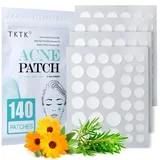
A spot with a lot of fluid can fill a patch before morning. Our instructions cover that case: reapply another patch, depending on the size and stage of the whitehead. Two rounds on a stubborn spot is normal use, and a pack of 140 Original Dots at $6.99 leaves room for it.
Daytime patches and night patches
Any hydrocolloid patch works at any hour. The difference between a day patch and a night patch is how it looks on your face, and that comes down to the edge.
A standard dot has the same thickness from center to rim. In daylight the rim casts a thin shadow and catches foundation. A daytime dot tapers toward the rim until the edge is almost flush with the skin.
| Item | Edge as stated | Sizes | From, per patch |
|---|---|---|---|
| Invisible+ Patches | 0.01 cm | 12 mm, 15 mm | 13.5¢ |
| Ultra-Thin Invisible | 0.01 cm | 10 mm, 12 mm | 3.8¢ |
| Invisible Pro | 0.01 cm | 10 mm, 12 mm | 3.9¢ |
| Chin Patches | 0.45 mm | 8 mm, 10 mm, 12 mm, 14 mm, 38 x 26 mm, 62 x 42 mm | 4.3¢ |
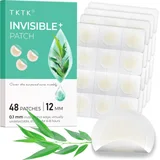
Three packs in the invisible line state an edge of 0.01 cm. Two of them, the Invisible+ Patches and the Invisible Pro, also state a matte finish, which keeps a patch from shining under office light.
Under makeup
Put the patch on first, on clean dry skin, and apply makeup over and around it. A patch pressed onto foundation will lift within the hour. The Ultra-Thin Invisible is plain hydrocolloid in 10 and 12 mm, and its box holds 168 patches for $7.99.
Keep your expectations honest. Up close, in side light, a patch is visible. At talking distance a thin matte dot under a light layer of base reads as skin.
Sweat and showers
A sealed patch tolerates some water. The Invisible Pro pack names exercise, commuting and showering as things it stays on through. Check the rim after a shower and replace a patch that has lifted.

At night the edge matters less and size matters more. A larger patch covers more skin and has more rim to hold against a pillow. That is where the large patches come in.
Patches with added ingredients
Most TKTK packs list one thing: hydrocolloid. A few add something to it. We repeat what each box lists and read no more into it than the label gives.
| Item | Listed ingredients | Fragrance |
|---|---|---|
| Original Dots | Hydrocolloid, tea tree oil, calendula oil | Not stated on the pack |
| Clear Cover Dots | Hydrocolloid, tea tree oil, calendula oil | Not stated on the pack |
| Bulk Variety Pack | Hydrocolloid | None added, per the pack |
| Microdart Patches | Hydrocolloid, salicylic acid, niacinamide, sodium hyaluronate | Not stated on the pack |
| All-in-One Combo Pack | Hydrocolloid | None added, per the pack |
| Invisible+ Patches | Hydrocolloid, salicylic acid | Not stated on the pack |
| Ultra-Thin Invisible | Hydrocolloid | None added, per the pack |
| Invisible Pro | Hydrocolloid | None added, per the pack |
| Large+ Strips | Hydrocolloid | None added, per the pack |
| Large+ XL Ovals | Hydrocolloid | None added, per the pack |
| Large+ Face and Body | Hydrocolloid | None added, per the pack |
| XL Stickers | Hydrocolloid | None added, per the pack |
| Large Patches, 4 Big Sizes | Hydrocolloid | None added, per the pack |
| 45 mm Squares | Hydrocolloid | None added, per the pack |
| Large+ 68 x 27 Strips | Hydrocolloid | None added, per the pack |
| Hydrocolloid Roll | Hydrocolloid | None added, per the pack |
| Variety Pack, 4 Shapes | Hydrocolloid | None added, per the pack |
| Large+ Nose Patch | Hydrocolloid | None added, per the pack |
| Chin Patches | Hydrocolloid | None added, per the pack |
| Moon Contoured Patches | Hydrocolloid | None added, per the pack |
| Blackhead Nose Kit | Witch hazel, purslane, houttuynia cordata, golden chamomile, medicinal lignosus rhizoma | Not stated on the pack |
Salicylic acid
Two packs list salicylic acid. The 12 mm Invisible+ Patches states hydrophilic hydrocolloids and salicylic acid at 0.09%, and names willow bark as the source. The Microdart Patches lists salicylic acid without a percentage.
US rules class salicylic acid as an acne drug ingredient within a set range. The federal list reads:
“(d) Salicylic acid, 0.5 to 2 percent.”
Our stated 0.09% is under that range. We sell these as cover patches that happen to list the ingredient, and we make no acne-drug claim for them. The line between the two kinds of product is drawn by what a maker says the product is for.
“Whether a product is a cosmetic or a drug under the law is determined by a product's intended use.”
What the ingredient itself is known for is a question for medical sources, not for a patch maker. Mayo Clinic sums up the evidence with some reserve.
“Salicylic acid may help prevent plugged hair follicles and is available as both wash-off and leave-on products. Studies showing its effectiveness are limited.”
Tea tree and calendula oil
The Original Dots and the Clear Cover Dots list tea tree oil and calendula oil next to hydrocolloid. They are our oldest packs and the most reviewed: the original holds 4.4 out of 5 across 10,323 ratings.
Some skin reacts to plant oils. If fragranced or botanical products have bothered you before, start with a plain pack instead. Cleveland Clinic makes the same point about additives in general.
“Some brands use ingredients such as salicylic acid or tea tree oil to dry out pimples, which may irritate an already irritated area.”
Microdarts
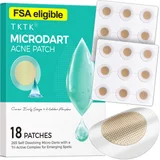
A microdart patch has tiny points on the skin side that dissolve after you press it on. Our box describes “265 self-dissolving microdarts in a wide 9mm area” and lists salicylic acid, niacinamide and sodium hyaluronate.
We sell the Microdart Patches for early bumps that have no head yet, the kind a flat patch finds nothing in. A box of 18 costs $6.99, which makes it the dearest patch in the range per piece.
Looking after the skin around the patch
A patch handles one spot. The rest of your face still needs ordinary care, and ordinary is the right word. Acne is not a hygiene problem.
“Another common myth is that dirty skin causes acne; however, blackheads and pimples are not caused by dirt.”
So there is no need to scrub. Wash with a mild cleanser, rinse, and pat dry. Then patch the spot before any serum or cream goes on, and work your other products around it.
When the patch comes off, the skin under it is often pale and a little wrinkled, like a fingertip after a bath. Let the area breathe for a few minutes before the next patch or your moisturizer.
Hands off, patch or no patch
The rule that makes patches useful applies to bare skin too. Every medical source we read repeats it.
“Avoid rubbing and touching skin lesions. Squeezing or picking blemishes can cause scars or dark blotches to develop.”
“Keep your hands away from your face. Touching, picking, and popping can worsen acne.”
If you catch yourself touching one area all day, cover it. A strip across the chin or a Chin Patches crescent turns a habit into a non-event. The chin pack holds 235 patches for $9.99.
A patch is not your acne routine
If you use a wash or a leave-on product for acne, keep using it as directed. A patch does not replace it and does not interfere with it, as long as the patch goes on clean, dry skin first.
“Choose a product that contains one of these acne-fighting active ingredients: adapalene, azelaic acid, benzoyl peroxide, or salicylic acid.”
How long skin care takes, and when to see a dermatologist
A patch works on a scale of hours. Skin care works on a scale of weeks. Mixing up the two is the fastest way to give up on something that was working.
The American Academy of Dermatology gives waiting times on several of its pages, and they are not identical. Each figure comes with its own advice, so they stay separate here.
“Give an acne treatment at least 4 weeks to work.”
“Treatment takes time to work. If you don’t see results in 4 to 6 weeks, a dermatologist can help you clear your skin.”
“You want to use a product for 6 to 8 weeks. It takes that long to see some improvement.”
Read together, they say this: judge a new product in weeks, not days, and count on a month at the least. Full clearing takes longer still.
“Complete clearing generally takes 3 to 4 months.”
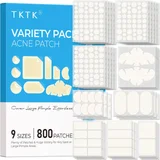
Patches fit inside that timeline as a daily tool. They deal with today’s spot while the slower products do their work. The All-in-One Combo Pack holds 800 patches in nine sizes for $19.99.
Signs that a patch is not enough
- Deep, painful lumps that return in the same places
- Spots that leave pits or dark marks behind
- No change after six to eight weeks of steady care
- Acne that starts or flares in adult life with no clear reason
- Any spot that grows hot, swollen and more painful by the day
“If you have deep or painful acne, seeing a dermatologist is necessary to help clear your acne.”
Adults are not exempt. Acne that begins at 30 or 40 is common enough to have its own name, and it is a good reason to book a visit instead of buying a bigger box.
“It is even possible to get acne for the first time as an adult. Dermatologists call this “adult-onset acne.””
“If you don’t see results from treatment in six to eight weeks, see a dermatologist.”
Who should skip patches, and common mistakes
Hydrocolloid suits most skin, and our packs describe it as non-irritating. Most is not all. The adhesive is the usual culprit when a patch disagrees with someone.
If medical tape or plasters leave you red and itchy, test one patch on your jaw for a few hours before you wear one overnight. Stop if a rash appears. The warning on our packs is short: discontinue use if you feel unwell.
Skip a patch when
- The skin is broken over a wide area, sunburnt or peeling from a strong active
- You have a known allergy to adhesives
- The spot is a deep lump with no head and you expect the patch to bring one up
- The area is covered in thick hair, where no patch seals
Mistakes that waste patches
The first is patching over skin care. A patch laid on moisturizer, sunscreen or spot cream slides and peels at the rim. Patch first, then build the rest of your routine around it.
The second is damp skin. Water under the patch stops the seal from forming. Wait a full minute after washing, or press a tissue on the area first.
“Popping a pimple may seem like the fastest way to clear it, but popping it can actually make things worse.”
The third is a patch that is too small. When the rim sits on the bump itself, fluid creeps out at the side and the patch lifts. Go one size up.
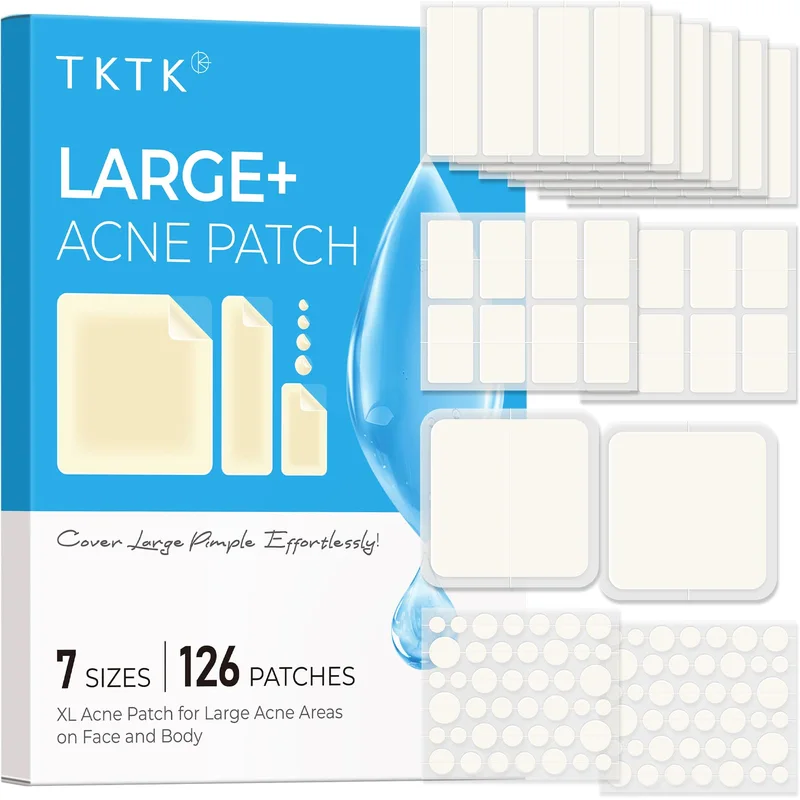
Mixed packs make sizing up easy. The Large+ Face and Body carries seven sizes, from 8 mm dots to a 60 mm square, and a box of 126 costs $7.99.
The fourth is checking. Each lift of the corner lets air in and weakens the grip. Put it on, set a time and leave it.
The last is using patches as the whole plan. A patch covers a spot you already have. It does nothing about the next one.
Choosing a first pack
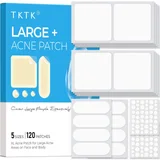
Start from where your spots are and when you want to wear the patch. Those two answers narrow 21 products to two or three.
- Single spots on the face, worn at night: a pack of round dots
- Spots you want covered at work or school: a thin-edge dot from the invisible line
- Rows and clusters on the forehead or jaw: strips
- Back, chest and shoulders: squares, XL ovals or a length cut from the roll
- A bit of everything: a variety box
Price rarely decides it. Across the TKTK lineup a box costs from $5.38 to $29.97, and plain dots cost 1.4¢ each in the Bulk Variety Pack. Buy the shape you need first and the count second.
If you want two shapes at once, we also sell 29 two-box sets that pair a dot pack with a large pack.
For exact diameters and the cost of each patch, read the TKTK size guide. For the big shapes, the nose and chin patches and the roll, read the guide to large patches for face and body.
Whichever box you open, the routine stays the same: clean, dry skin, a patch with a margin, and hours instead of minutes. Then look at what the patch found. Make an honest call on whether that spot was one for a patch at all.